
Depression or Burnout – When Exhaustion Becomes an Illness

Do you constantly feel tired, emotionally drained, or simply “worn out” – even after a restful weekend? When exhaustion persists despite rest, it is often more than just temporary stress. More and more people suffer from this chronic lack of energy. But many ask themselves the same question:
“Am I suffering from burnout – or is depression already behind it?“
The problem: the symptoms overlap significantly. At the same time, these terms are often misused in everyday language. As a result, illnesses go unrecognized for too long – and remain untreated.
In this article you will learn:
- What burnout and depression are – and which warning signs to look for
- The 7 key differences – depression vs. burnout
- When burnout can turn into depression
- Our self-check: Am I suffering from burnout or depression?
- Treatment options – what really helps
Our aim is to give you orientation – clearly, thoroughly, and without panic-mongering.
01. What is Burnout?
Burnout is a state of deep emotional, physical, and mental exhaustion caused by persistent, uncontrollable stress – usually in a professional context. Those affected feel burned out, internally empty, and increasingly detached from their work and surroundings.
ICD-11 Classification
The World Health Organization (WHO) classifies burnout in ICD-11 not as a disease, but as an occupational syndrome.
This means:
- Burnout is a risk condition
- Not an independent psychiatric diagnosis
- But it can develop into serious illness
Typical Symptoms of Burnout
- Emotional exhaustion
- Cynicism toward work or people
- Decreased performance
- Sleep disturbances
- Irritability
Important: These symptoms strongly resemble those of depression – but are initially context-related (mostly work-related).
👉 If you notice several of these signs over a period of at least two weeks, you should act and seek professional help.
Causes of Burnout
Burnout rarely has a single cause. It is usually a complex interplay of external stressors and internal drivers. In the modern working world (Burnout 2.0), digital overload and the blurring of work and private life also play a central role.
External Stress Factors (Environment & Work)
- Poor working environment
- Lack of control
- Lack of recognition
- Chronic time and performance pressure
Internal Risk Factors (Personality)
- Perfectionism
- Helper syndrome
- High sense of responsibility
- Difficulty setting boundaries
Click the button below to learn more about the phenomenon of Burnout 2.0 and the various burnout phases.
02. What is Depression?
A depression is far more than a temporary phase of sadness; it is a serious but treatable mental illness. Characteristic of clinical depression are persistent symptoms such as lack of drive, a deep inner emptiness, and the loss of joy and interest in familiar activities (anhedonia).
Typical Symptoms of Depression
To identify a clinical depression, a distinction is usually made between primary and additional symptoms.
The Three Primary Symptoms
- Depressed mood
- Loss of interest (anhedonia)
- Lack of drive
Common Additional Symptoms
- Guilt & self-doubt
- Concentration and attention disorders
- Sleep disturbances
- Loss of appetite or weight changes
- Suicidal thoughts
👉 If you notice several of these signs over a period of at least two weeks, you should act and seek professional help.
Causes of Depression: An Interplay of Many Factors
The development of depression is almost always multifactorial. This means that rarely just one single trigger is responsible; rather, various influences work together. In modern psychiatry, the biopsychosocial model is used to understand the complex causes:
Biological & Neurobiological Factors
- Brain metabolism
- Genetic predisposition
- Physical illnesses
Psychological Factors & Life History
- Traumatic experiences
- Personality structure
Social & Environmental Factors
- Chronic stress
- Loneliness
Click the button below to learn more about the symptoms and causes as well as the different phases of depression.
03. Depression and Burnout – 10 Key Warning Signs
Here is a checklist of typical burnout symptoms and signs of depression.
Checklist: Recognizing Warning Signs
- Constant fatigue despite adequate sleep
- Feeling of inner emptiness
- Concentration problems
- Loss of enjoyment in activities
- Irritability or emotional numbness
- Sleep disturbances
- Withdrawal from social contacts
- Feeling of meaninglessness
- Physical complaints without a clear cause
- Lack of motivation in daily life
⚠️ Important: This list does not replace a professional diagnosis.
04. Depression vs. Burnout – Where is the Difference?
Although the symptoms often overlap, there are clear clinical distinctions between burnout syndrome and a depressive episode. The following comparison table shows you the 7 key differences at a glance:
Comparison Table: The 7 Key Differences
Comparison Table: Burnout vs. Depression (7 Differences)
| Criterion | Burnout | Depression |
|---|---|---|
| Cause | Mostly work-related | Multifactorial (biological + psychological) |
| Mood | Mainly negative at work | Persistently low |
| Drive | Selectively reduced | Strongly reduced (all areas of life) |
| Self-esteem | Often preserved | Often significantly lowered |
| Joy (Anhedonia) | Partially present | Mostly completely lost |
| Sleep | Difficulty falling asleep (racing thoughts) | Typical early waking |
| Response to rest | Improvement with vacation/leisure | No improvement (inner heaviness remains) |
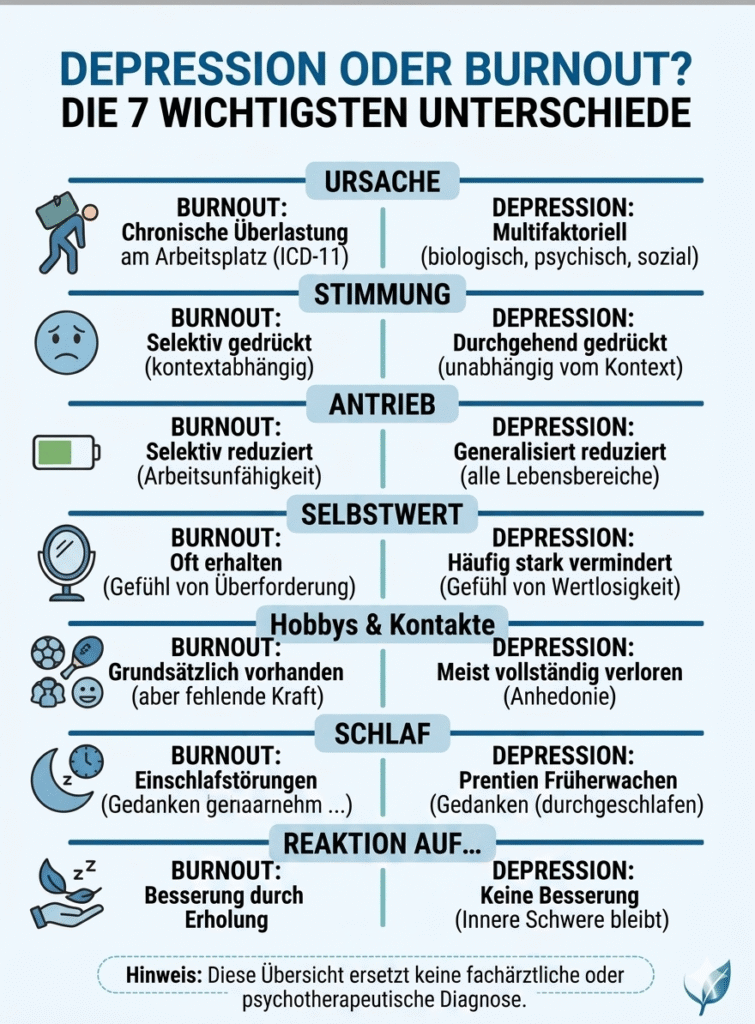
⚠️ Important: The transitions between severe burnout and clinical depression are often fluid. A precise differential diagnosis by a specialist is therefore essential to avoid chronification.
05. When Does Burnout Turn into Depression?
A crucial point: Burnout can develop into depression.
This often happens when:
- Stressors persist long-term
- No recovery is possible
- Early warning signs are ignored
The exhaustion then develops into what is called exhaustion depression.
Transitions and Overlaps
In medical practice, a strict separation is often difficult, as burnout and depression frequently occur together. Burnout can begin as a state of exhaustion and, without relief, transition into clinical depression.
The German Society for Psychiatry and Psychotherapy emphasizes:
Accurate diagnosis is crucial, as treatment approaches differ.
📍 Case Study: A Look Into Practice
- The case: Project manager with chronic exhaustion and focus on time management.
- The observation: Loss of interest at weekends, inner emptiness and morning rumination.
- The diagnosis: Transition from burnout to moderate depressive episode.
- The therapy: Combination of supportive psychotherapy and medication.
- The conclusion: Recovery through healthy boundaries rather than pure performance optimization.
06. Self-Check: Am I Suffering from Burnout or Depression?
Please take a brief moment to reflect on your feelings over the past two weeks. Answer the questions below honestly to see the detailed differences between burnout and depression:
👉 Would you like professional support? Schedule your first consultation now.
07. Treatment Options – What Really Helps
The good news: both burnout and depression are treatable.
Psychotherapy
Psychotherapy forms the foundation of treatment.
Commonly used in Germany:
- Cognitive Behavioral Therapy (CBT)
- Psychodynamic therapy
Goals:
- Improve the management of stress
- Recognize negative thought patterns
- Build emotional stability
Medication-Based Treatment
For depression, medication support can be beneficial.
- Act on neurotransmitter balance
- Individually adjusted by physician
- Combination with psychotherapy recommended
⚠️ Important: No self-medication!
Digital Health Applications (DiGA)
In Germany, certain apps can be prescribed on prescription. Examples:
- Stress management
- Depression support
- Sleep improvement
Self-Help Strategies (Evidence-Based)
- Regular exercise (proven antidepressant effect)
- Structured daily routine
- Mindfulness & meditation
- Maintaining social contacts
- Setting boundaries (especially at work)
Even small changes can have a big impact.
08. Conclusion
Depression or burnout – the distinction is not just theoretical, but crucial for your health.
Burnout often starts gradually as everyday overwhelm. If ignored, it can develop into serious depression. That is why it is so important to recognize warning signs early and seek professional help.
You do not have to walk this path alone. There are many services available – from psychotherapy to digital applications and specialized counseling centers.
👉 If this resonates with you: Don’t wait too long. Talk to your primary care physician, a specialist, or actively seek professional support.
Your mental health is not a luxury – it is a prerequisite for a fulfilling life.
FAQ – Frequently Asked Questions
Is burnout a recognized medical condition?
According to ICD-11, burnout is not an independent medical condition, but a work-related syndrome. In practice, another diagnosis such as depression or adjustment disorder is often made to enable treatment.
Is burnout the same as depression?
Burnout is not the same as depression, but it can develop into one. While burnout typically stems from occupational overload, depression affects all areas of life and often has biological causes. An accurate diagnosis by a specialist is therefore essential.
Can burnout turn into depression?
Yes. If stressors persist and no recovery is possible, burnout can develop into clinical depression — known as exhaustion depression. Early professional support is important to prevent this transition.
How long does recovery from depression take?
Recovery time varies individually. With professional treatment, significant improvement can often be achieved within weeks to months. The earlier treatment begins, the better the prognosis.
When should I see a doctor for burnout or depression?
You should seek medical help if exhaustion persists for several weeks, worsens, or significantly affects your daily life. Particularly if you notice persistent lack of motivation, inner emptiness, or sleep disturbances — a professional assessment is important.
What does health insurance cover for burnout?
Psychotherapy is covered for diagnosed mental illnesses. In practice, burnout is often classified as depression or adjustment disorder to enable coverage by statutory health insurance.
Ezgi Öztas Sevimli – Specialist in Psychiatry and Psychotherapy

“Dear reader,
I hope this article was helpful and you read it with interest. As a specialist physician, it is important to me not only to provide medical advice to those who come to me, but to understand each person as a whole. Burnout and depression are not signs of weakness, but signals from your body that must be taken seriously. Please do not hesitate to contact me if you feel you need professional support. Together we will develop an individual therapy plan to help you regain your joy in life.”